CNS · inflammatory
Relapsing-remitting MS (select cases)
Stable disease-modifying therapy, documented active inflammation, treating neurologist willing to co-manage. Not a DMT replacement. A potential adjunct.
Systemic and complex-condition programs are the most consequential work we do. And the most uncertain. We run a long evaluation before we treat, and we decline more applicants than we accept. If we think the honest answer is "not this therapy," we will say so.
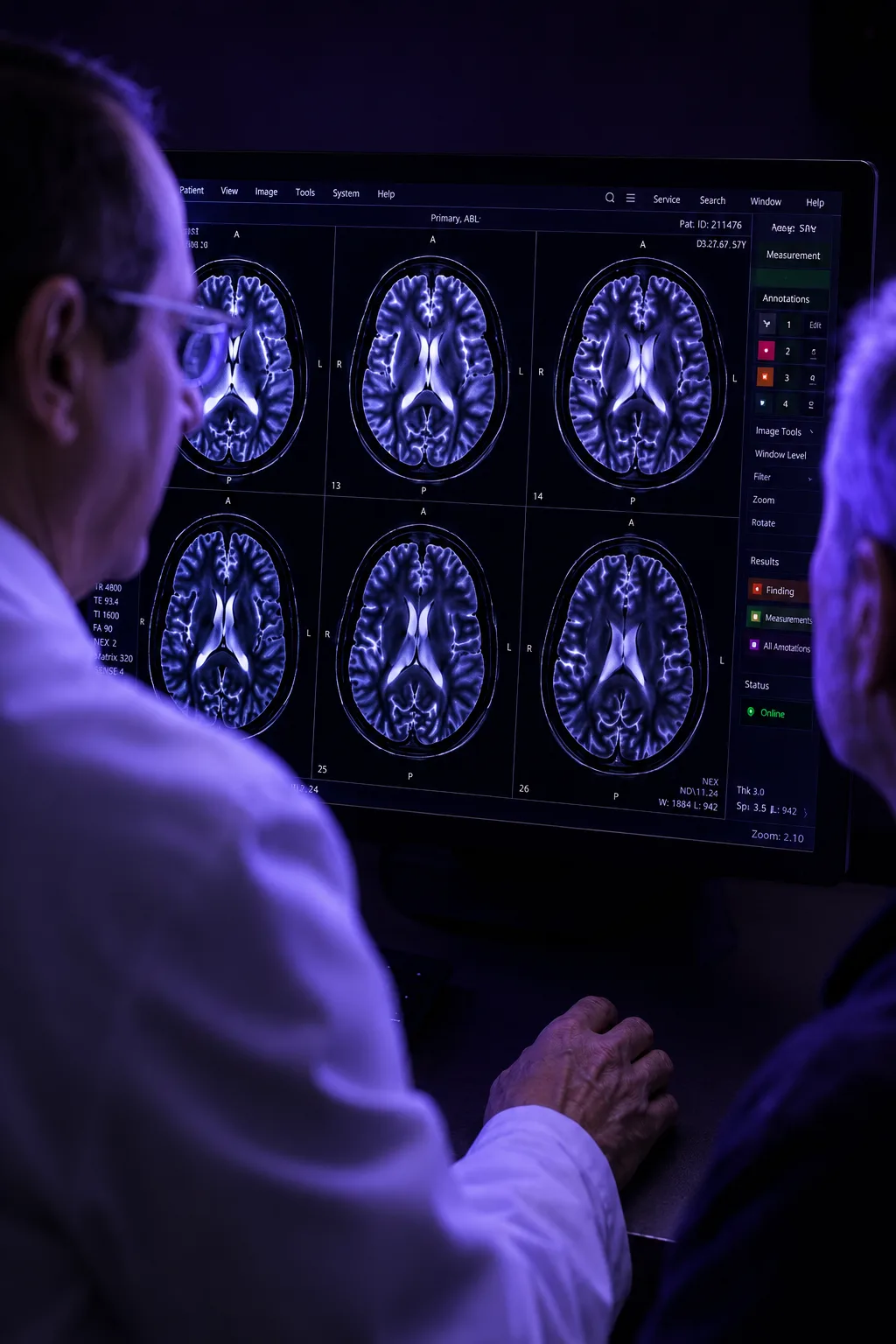
There is credible evidence that mesenchymal stem cells can modulate neuroinflammation and, in specific conditions, support function. There is not yet credible evidence that they reverse established neurodegeneration, regrow myelin at scale, or restore lost neurons in a clinically meaningful way.
We operate in the window between those two statements. For some patients (with the right condition, the right disease stage, and realistic expectations) that window is worth entering. For many, it isn't.
Everything below is written assuming you want the real picture, not the marketing one.
We do not treat every diagnosis we're asked about. Below is where we believe the current evidence supports cautious intervention, and where it clearly does not. This list grows as data matures across autoimmune, neurologic, and cardiovascular indications.
Stable disease-modifying therapy, documented active inflammation, treating neurologist willing to co-manage. Not a DMT replacement. A potential adjunct.
Biopsy or QSART-confirmed, symptoms < 24 months, failed standard care. We have modest but consistent signal here, across patient-reported and autonomic testing.
Post-infectious or autoimmune phenotype, failed tilt-table directed therapy. We stratify aggressively. The label covers very different biology.
6–36 months post-event, plateaued on standard rehab, stable imaging. Modest functional signal in distal limb control for a subset of patients.
We decline late-stage applicants where structural loss is advanced. Evidence does not support meaningful functional benefit at that stage. Early-to-mid ALS is considered separately, for quality-of-life support only, never framed as disease-modifying or a cure.
No current protocol can restore established cortical loss. Early-stage, well-characterized patients are occasionally considered in research contexts only. Never as a billed treatment.
Acute SCI belongs in trial protocols at Level-1 centers, not in a private clinic. Chronic cases > 12 months post-event, with stable imaging, we discuss. Individually, skeptically.
We will not sell hope that isn't supported. If the intake form describes expected outcomes we know are unreachable with current cell therapy, we end the process there. Candidly.
For systemic and complex indications the goal is to recalibrate the upstream biology — chronic inflammation, dysregulated immune activity, compromised perfusion, neuroinflammation where present — so the body's own repair machinery can function again. The signaling persists well beyond the cells themselves.
Suppresses the chronic inflammatory signaling driving pain, dysfunction, and progressive tissue damage — systemically.
Interrupts the fibrotic cascade that replaces functional tissue with scar, a downstream consequence of chronic inflammation.
Recalibrates dysregulated immune activity across the body without systemic immune suppression.
Supports formation of new vascular networks, improving tissue perfusion and creating a more favorable systemic repair environment.
Systemic and complex cases demand more than a blood panel and a consult. Every applicant we take past intake goes through a multi-disciplinary review. We say yes, no, or "come back when X changes." We'll tell you which.
Full medical history, imaging, neurology notes, prior treatment trials. We need everything, including what didn't work.
45-minute call with a Celva patient coordinator. The physician team in Mexico then reviews independently — focused on disease stage, medication stability, and whether the evaluation should proceed. Not a sales call.
Each case is reviewed by the physician team's regenerative attending with outside specialty consultation (neurology, rheumatology, cardiology, or other as relevant) and, where appropriate, PM&R review. Multiple opinions inform every decision.
If we're considering acceptance: functional testing, autonomic battery, disease-specific scales (EDSS, COMPASS-31, Fugl-Meyer, etc.). Captured before any decision is finalized.
One of three outcomes, in writing:
Accept, with a specific protocol, expected magnitude, and measurement plan.
Decline, with the reason, and any referrals we can make.
Revisit, with the conditions under which we would re-open the case.
We are selective in patient acceptance and only move forward when a case appears clinically appropriate and expectations are realistic. Each application moves through intake, records screen, multi-disciplinary panel review, and a written plan. Cases that don't fit are declined in writing, with a referral when one is available.
Systemic and complex protocols are tailored. Dose, route, and cadence depend on condition and disease stage. Below is the common architecture. Specifics live in your written plan.
IV (and IT where indicated) under attending supervision. Short inpatient window for intrathecal cases. Functional re-test at day 14 and day 45.
We re-run your functional battery and compare to baseline. If the delta is below our pre-agreed floor, we pause. No automatic dose two.
Second treatment at 4–6 months. Dose adjusted on response. Same observation protocol, same re-test cadence.
Repeat full battery. The question we answer: is continuation doing something we can defend in writing? If not, we stop and say so.
Final treatment for responders. Comprehensive handoff package to your treating neurologist: all data, all trajectories, everything we'd want if we were on their end of the chart.
"I wanted so badly to accept him. He'd already flown to four clinics. What he needed, what would have been honest, was hospice planning and time with his family. We said so. He thanked us. That's the one I think about."
We would rather lose an application at this stage than at the written-decline stage four weeks later.
Systemic and complex cases are never standard. The plan is designed only after the physician team's review.
There is no fixed protocol for this track. Depending on your case, the team may recommend a single diagnostic dose with a 90-day re-evaluation, or a structured multi-dose protocol with quarterly re-measurement and a written handoff to your treating specialist. That decision is made from your records, not in advance.
And the team can stop. If the data at the first 90-day decision point doesn't support continuing, they pause the program and tell you plainly. We want that decision to be easy for us to make.
Start an intake and a Celva patient coordinator gathers your case for the physician team's independent review. Nothing is scheduled until that review is complete and you have decided to move forward.
Start your intake →For patients and families who want the detailed read on candidacy, expectations, and how the evaluation actually works. One page per topic.
Not a sales call. A records review, a screen, and a multi-disciplinary opinion. If we accept you, we'll tell you what to expect. In writing. If we don't, we'll tell you why, and where we think you should look next.